
10 SEO Tasks You Should Do Every Month (30-Minute Checklist)
Let me ask you something: when was the last time you actually touched your website’s SEO?
If you’re like most small business owners, the answer is probably “when I first set it up” or “never.” And honestly? I get it. You’re running a business. You’ve got customers to serve, products to ship, invoices to send, fires to put out.
But here’s the brutal reality: SEO requires both big-picture thinking and the ability to tackle daily tasks and action items. And while you can’t ignore it, you also can’t spend hours every day on it.
The solution? A simple monthly routine.
I’m going to give you 10 essential SEO tasks that take just 30 minutes total when you do them monthly. No technical jargon. No overwhelming complexity. Just straightforward actions that keep your website healthy, visible, and climbing in search rankings.
Sound good? Let’s dive in.
Why Monthly SEO Maintenance Matters
Think of your website like a car. You don’t wait until something breaks to check the oil, right? Regular maintenance—checking tire pressure, topping off fluids, replacing air filters—keeps your car running smoothly and prevents expensive problems down the road.
Your website works the same way.
SEO is a multifaceted discipline that requires a solid strategy, connection to broader digital marketing goals, and accountability. Without regular check-ups, small issues become big problems. Rankings slip. Traffic drops. Competitors pass you by.
But here’s the good news: monthly SEO maintenance doesn’t have to be complicated or time-consuming. In fact, with the right checklist, you can maintain—and improve—your SEO in about 30 minutes per month.
The benefits of a monthly SEO routine:
- Catch and fix problems before they tank your rankings
- Stay ahead of competitors who aren’t maintaining their SEO
- Build momentum with small, consistent improvements
- Track your progress and see what’s actually working
- Keep your content fresh and relevant
Modern search results are rich with features, so monthly SEO must focus on standing out in the search results. Let’s make sure you do.
Your 30-Minute Monthly SEO Checklist
Task #1: Check Your Google Search Console for Errors (5 minutes)
This is your first stop every month. Google Search Console (GSC) is a free tool that shows you exactly how Google sees your website—including any problems that might be hurting your rankings.
What to do:
- Log into Google Search Console
- Click on “Coverage” in the left sidebar
- Look for any errors (pages that aren’t indexed, crawl errors, etc.)
- Check the “Enhancements” section for any issues with mobile usability, structured data, or other features
- Address any critical errors immediately
What you’re looking for:
- Red alerts indicating serious problems
- Pages that should be indexed but aren’t
- Mobile usability issues
- Broken links or server errors
Set up Google Search Console or Bing Webmaster Tools to monitor your SEO performance and submit your pages to search engines. If you haven’t set up GSC yet, do it now. It’s absolutely essential for monthly SEO monitoring.
Quick win: Most errors have simple fixes. Often it’s just a matter of re-submitting a page for indexing or fixing a broken internal link.
Task #2: Review Your Top-Performing Content (5 minutes)
Your existing content is an asset. But it won’t stay relevant forever without some love.
What to do:
- Go to Google Analytics and look at your top 10 pages by organic traffic (last 30 days)
- Note which pages are performing well
- Identify any pages that used to perform well but are declining
- Make a list of 2-3 pieces to update next month
Why this matters:
Content that’s outdated or no longer accurate will gradually lose rankings. But refreshing it with new information, updated statistics, or improved formatting can give it new life.
Monthly SEO should always include reviewing the distribution of content performance to ensure you’re focusing your efforts on high-impact pages. Regular monitoring and updates are essential, with a suggested frequency of at least once a month for routine checks.
What to update:
- Old statistics with current data
- Outdated screenshots or examples
- New sections addressing recent developments
- Improved formatting for better readability
- Additional internal links to newer content
Task #3: Monitor Your Keyword Rankings (3 minutes)
You can’t improve what you don’t measure. Tracking your keyword rankings helps you understand if your SEO efforts are working.
What to do:
- Check your rankings for your top 5-10 most important keywords
- Note any significant changes (up or down)
- Celebrate wins and investigate losses
Use a rank tracking tool like PokkadotSEO’s Rank Tracker to automate this. You’ll see at a glance which keywords are moving up, which are stuck, and which are sliding down.
What the data tells you:
- If rankings are improving: Keep doing what you’re doing
- If rankings are flat: Consider refreshing that content or building more links
- If rankings are dropping: Check for technical issues, stronger competitor content, or Google algorithm updates
Tracking your rankings in search results can help you understand if the rest of your SEO efforts are working.
Task #4: Add Internal Links to New Content (3 minutes)
Internal linking is one of the most underutilized SEO tactics. It helps search engines discover your content, distributes ranking power throughout your site, and keeps visitors engaged longer.
What to do:
- Look at any new content you published in the last month
- Go back to 2-3 older, related blog posts
- Add contextual links from the old posts to the new content
- Make sure the anchor text is natural and descriptive
Example: If you just published “10 Local SEO Tips for Restaurants,” go back to your older post about “How to Grow Your Restaurant Business” and add a link like: “For more specific tactics, check out our guide to local SEO for restaurants.”
Healthy internal linking improves both SEO and user experience. Research shows that enhancing internal linking can increase average session duration by 25%.
Pro tip: Use PokkadotSEO’s Site Audit to identify “orphan pages”—pages with no internal links pointing to them. These pages are harder for Google to find and rank.
Task #5: Check Your Site Speed (2 minutes)
Page speed is a confirmed ranking factor, and it directly impacts user experience. Slow sites rank lower and convert worse. Period.
What to do:
- Go to Google PageSpeed Insights
- Test your homepage and your top 2-3 most important pages
- Note your scores for both mobile and desktop
- If scores are below 50, prioritize speed improvements
Common quick fixes:
- Compress images (often the biggest culprit)
- Enable browser caching
- Minimize CSS and JavaScript files
- Use a Content Delivery Network (CDN)
Pages loading within two seconds have a bounce rate of 9%, while pages loading within more than five seconds have bounce rates of over 38%. Speed matters.
Task #6: Update Your Meta Descriptions (3 minutes)
Meta descriptions don’t directly impact rankings, but they massively impact click-through rates. A compelling meta description can make the difference between someone clicking your result or your competitor’s.
What to do:
- Pick 2-3 of your most important pages
- Check their current meta descriptions
- Rewrite any that are generic, missing, or don’t include a clear benefit
What makes a good meta description:
- 150-160 characters (Google’s display limit)
- Includes your target keyword naturally
- Clearly states the benefit or value
- Has a subtle call-to-action
- Matches the content on the page
Example: Bad: “This page is about SEO for small businesses.” Good: “Discover 10 proven SEO strategies that help small businesses rank higher and get more customers—without expensive agencies or complex tools.”
Use PokkadotSEO’s Content Analyzer to check which pages are missing meta descriptions or have ones that are too short/long.
Task #7: Look for Broken Links (2 minutes)
Broken links are bad news. They create dead ends for visitors, waste Google’s crawl budget, and signal that your site might not be well-maintained.
What to do:
- Use a tool like PokkadotSEO’s Site Audit or a free browser extension to scan for broken links
- Fix any broken internal links by updating them to the correct URL
- Either fix or remove broken external links
Types of broken links to watch for:
- 404 errors (page doesn’t exist)
- Redirect chains (link goes through multiple redirects)
- Links to pages that have moved without a redirect
Monthly SEO should always include a scan for broken or redirected internal links to keep your site architecture strong.
Quick fix: If you’ve deleted a page, set up a 301 redirect from the old URL to a relevant existing page. This preserves any SEO value that old page had.
Task #8: Review Your Backlink Profile (3 minutes)
Backlinks—links from other websites to yours—are one of the most important ranking factors. But not all backlinks are good. Some can actually hurt you.
What to do:
- Check your backlink profile using Google Search Console or PokkadotSEO’s Backlink Checker
- Look for any new backlinks you’ve gained in the last month
- Identify any spammy or low-quality links
- Consider disavowing harmful links if needed
What you’re looking for:
- Positive: Links from reputable sites in your industry
- Neutral: Links from directories or aggregate sites
- Negative: Links from spam sites, link farms, or unrelated foreign language sites
Also note: Are your competitors gaining more backlinks than you? If so, you might want to step up your link-building efforts.
Task #9: Optimize for One Featured Snippet (2 minutes)
Featured snippets are the coveted “position zero” spots in Google—the boxes that appear above regular search results answering a question directly.
Getting a featured snippet can dramatically increase your traffic for that keyword.
What to do:
- Use Google Search Console to find keywords you rank #2-10 for
- Search those keywords and see if there’s a featured snippet
- Look at the format (paragraph, list, table, etc.)
- Update your content to match that format and provide a better, more concise answer
Example: If there’s a featured snippet for “how to optimize meta descriptions” showing a numbered list, make sure your content has a clear, scannable numbered list answering that question.
Featured snippets are easier to capture than you think, especially if you’re already ranking on page one.
Task #10: Publish or Schedule One New Piece of Content (2 minutes)
Okay, this one’s not exactly a “maintenance” task, but it’s the most important thing you can do monthly for SEO growth.
Google loves fresh, valuable content. Websites that regularly publish new content tend to rank higher and get more traffic than stagnant sites.
What to do:
- Publish one new blog post, guide, FAQ page, or piece of valuable content
- If you don’t have time to write it this month, at least schedule it for next month
- Make sure it’s optimized for SEO before publishing (use PokkadotSEO’s Content Analyzer)
It doesn’t have to be a 3,000-word masterpiece. A focused 800-word post answering a specific question your customers ask is valuable. The key is consistency.
Publishing one new piece of content monthly means 12 new pages ranking in Google by the end of the year. That’s 12 more opportunities for people to discover your business.
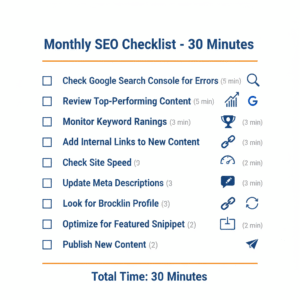
The 30-Minute Breakdown
Let’s do the math:
- Check Google Search Console – 5 minutes
- Review top-performing content – 5 minutes
- Monitor keyword rankings – 3 minutes
- Add internal links – 3 minutes
- Check site speed – 2 minutes
- Update meta descriptions – 3 minutes
- Look for broken links – 2 minutes
- Review backlink profile – 3 minutes
- Optimize for a featured snippet – 2 minutes
- Publish new content – 2 minutes
Total: 30 minutes
That’s it. Half an hour per month to keep your SEO healthy, growing, and competitive.
Making It Even Easier: Your Monthly SEO Day
Here’s how I recommend structuring your monthly SEO maintenance:
Pick one day each month. Let’s say the first Tuesday. Put it on your calendar. Call it “SEO Day” or “Website Maintenance Day” or “30-Minute Rankings Boost”—whatever makes you actually do it.
Set a timer for 30 minutes. When the timer starts, work through this checklist. Don’t get distracted. Don’t go down rabbit holes. Just complete the tasks.
Track what you find. Keep a simple spreadsheet or notes document where you record:
- Date completed
- Any issues found
- Actions taken
- Rankings for your key keywords
Celebrate small wins. Moved up 3 spots for an important keyword? Fixed a critical error? Published a great new post? These are wins. Acknowledge them.
Over 12 months, you’ll have touched your SEO 12 times. That’s 12 checkups, 12 rounds of improvements, 12 new pieces of content. The compound effect is powerful.
What If You Find Bigger Problems?
Sometimes your monthly checkup will reveal issues that take more than 2-3 minutes to fix. Maybe you discover 50 broken links. Or your site speed is terrible across the board. Or you realize your entire blog from 2019 needs updating.
Don’t panic. Don’t try to fix everything at once.
Instead:
- Note the problem
- Prioritize it (critical, important, or minor)
- Schedule time to address it outside your monthly 30 minutes
Your monthly checklist is about maintenance and monitoring. Major overhauls are separate projects.
SEO success is defined by a strategy, but accomplished by follow-through and implementation of daily, monthly, quarterly, and yearly tasks.
Common Monthly SEO Mistakes to Avoid
Mistake #1: Skipping months because you’re busy
This defeats the entire purpose. Monthly SEO works because of consistency. Missing a month means issues go unnoticed longer and momentum stalls.
Solution: Put it on your calendar with a reminder. Treat it like a client meeting you can’t miss.
Mistake #2: Spending too much time on low-impact tasks
It’s easy to spend 20 minutes agonizing over the perfect meta description for one page while ignoring critical errors in Search Console.
Solution: Stick to the time limits. If something needs more attention, note it and come back to it later.
Mistake #3: Not tracking your progress
If you don’t record your findings, you won’t see patterns or progress over time.
Solution: Keep a simple monthly SEO log. Even just jotting down your top 3 keyword rankings each month gives you a trend to follow.
Mistake #4: Doing tasks without a plan
Randomly doing “SEO best practices” without knowing why or how they fit into your bigger strategy wastes time and energy.
Solution: Understand the purpose of each task. Every item on this checklist exists to either prevent problems or create opportunities.
Mistake #5: Trying to do everything alone
SEO has a learning curve. If you’re constantly Googling how to do each task, your 30 minutes turns into 3 hours.
Solution: Use tools that simplify the process. PokkadotSEO’s tools automate the technical stuff and give you clear, actionable recommendations so you’re not guessing.
Beyond Monthly: Quarterly and Yearly SEO Tasks
While this checklist covers monthly essentials, there are some tasks you should do less frequently:
Quarterly (every 3 months):
- Comprehensive content audit (identify outdated or underperforming content)
- Competitor analysis (what are they doing that you’re not?)
- Technical SEO deep dive (site architecture, schema markup, crawlability)
- Backlink outreach campaign (proactively build new quality links)
Yearly (once per year):
- Complete SEO strategy review (are your goals still the same?)
- Full site redesign assessment (if applicable)
- Keyword strategy overhaul (trends change, search behavior evolves)
- Major content updates (refresh your most important pages)
Monthly tasks maintain your SEO. Quarterly and yearly tasks push it forward strategically.
Tools That Make Monthly SEO Actually Manageable
Trying to do monthly SEO without the right tools is like trying to fix a car without a wrench. Sure, you could maybe do it, but why make it harder than it needs to be?
Essential (Free) Tools:
- Google Search Console – Monitors site health and performance
- Google Analytics – Tracks traffic and user behavior
- Google PageSpeed Insights – Tests site speed
- Google Business Profile – Essential for local businesses
Highly Recommended (Affordable) Tools:
- PokkadotSEO – All-in-one toolkit built for small businesses
- Site Audit (finds technical issues automatically)
- Keyword Rank Tracking (monitors your positions)
- Content Analyzer (optimizes before you publish)
- Backlink Checker (monitors your link profile)
- Internal Link Analyzer (identifies opportunities)
The right tools turn a confusing, overwhelming process into a simple 30-minute checklist you can actually complete.
Real Results from Monthly SEO Maintenance
Let me share what consistent monthly SEO can do:
Case Study: Local Bakery
A small bakery committed to 30 minutes of monthly SEO for 12 months. Their routine:
- Month 1-3: Fixed technical errors, optimized existing pages
- Month 4-6: Added internal links, started publishing monthly blog posts
- Month 7-9: Optimized for local keywords, claimed more citations
- Month 10-12: Maintained rankings, expanded content topics
Results after 12 months:
- Organic traffic up 340%
- Ranking on page 1 for 15 local keywords (started with 2)
- 28 new blog posts published (2-3 per month, some skipped)
- Phone calls from Google increased 220%
This wasn’t magic. It was consistency. Thirty minutes, every month, for a year.
Your Monthly SEO Calendar Template
Want to make this even easier? Here’s a ready-to-use monthly calendar:
Week 1 (First Tuesday):
- Complete the 30-minute checklist
- Note any bigger issues to address later
Week 2:
- If you found issues last week, spend 30-60 minutes addressing the most critical one
Week 3:
- Work on your monthly blog post (draft it, optimize it, schedule it)
Week 4:
- Promote your new blog post (social media, email, etc.)
- Start thinking about next month’s topic
Total monthly time commitment: 2-3 hours (but the core checklist is still just 30 minutes)
This spreads the work across the month so it never feels overwhelming.
Frequently Asked Questions
Q: Do I really need to do this every single month?
Yes. SEO isn’t a “set it and forget it” thing. Search engines change, competitors optimize their sites, content gets outdated, and technical issues pop up. Monthly maintenance keeps you ahead of problems and consistently improving.
Q: What if I don’t have time to create new content monthly?
At minimum, do the other 9 tasks. But honestly, one 800-word blog post per month is doable for almost anyone. Batch write a few posts when you have time and schedule them. Or hire a freelancer for $50-100 per post.
Q: Can I batch these tasks and do them quarterly instead?
You could, but you’ll miss opportunities and let problems fester longer. Checking things monthly lets you catch issues while they’re still small and easy to fix.
Q: What if I find dozens of broken links or errors?
Fix the critical ones during your 30 minutes, then schedule dedicated time to fix the rest. Don’t let one big problem derail your whole routine.
Q: Should I hire someone to do this for me?
If budget allows, absolutely. An SEO professional can handle this and do deeper work. But if you’re bootstrapping, doing it yourself with good tools like PokkadotSEO is totally feasible.
Q: How long until I see results?
You’ll see small improvements (fixed errors, better rankings for a keyword or two) within 1-2 months. Significant traffic growth typically takes 4-6 months of consistent monthly work.
Q: What’s the #1 most important task on this list?
Publishing new content. Everything else maintains what you have. New content creates new opportunities to rank and attract visitors.
The Bottom Line: 30 Minutes That Compound
Here’s what most small business owners don’t realize: SEO isn’t about one big heroic effort. It’s about small, consistent actions that compound over time.
Thirty minutes per month doesn’t sound like much. And honestly, it isn’t. But do it every month for a year and you’ve invested 6 hours total into:
- 12 technical checkups
- 12 content reviews
- 12 ranking checks
- 12 new pieces of content
- Dozens of small optimizations
That’s 6 hours that can generate thousands of dollars in additional revenue from organic traffic.
Compare that to paid ads, where you have to keep paying forever to keep the traffic coming. Or to hiring an agency for $2,000+/month.
Monthly SEO maintenance is the highest-leverage activity most small business owners aren’t doing.
So here’s my challenge to you:
Pick a date. This month. Put it on your calendar. Set a 30-minute timer. Work through this checklist.
Then do it again next month. And the month after that.
In 12 months, come back and thank me when your organic traffic has doubled (or tripled).
Your website wants to rank. Your content wants to be found. Your business deserves the customers searching for what you offer.
Give it 30 minutes a month. That’s all it takes.
Ready to Make Monthly SEO Actually Easy?
Stop wasting time Googling “how to check for SEO errors” or manually tracking rankings in a spreadsheet.
PokkadotSEO gives you everything you need to complete this entire checklist in one dashboard.
✅ Site Audit – Automatically scans for technical issues every month
✅ Rank Tracker – Monitors your keyword positions without manual checking
✅ Content Analyzer – Optimizes your monthly blog post before you publish
✅ Backlink Monitor – Tracks new links and alerts you to spam
✅ Internal Link Tool – Finds linking opportunities automatically
✅ Speed Checker – Tests page speed with one click
No technical knowledge required. No confusing reports. Just clear, actionable tasks.
👉 Try PokkadotSEO free – Get 10 credits
Transform monthly SEO from an overwhelming chore into a simple 30-minute routine.
Your competitors are either ignoring SEO or paying thousands for agencies. Meanwhile, you’ll be maintaining and growing your rankings for less than the cost of a fancy coffee.
Start your monthly SEO routine today. Your future traffic—and revenue—will thank you.